Chemical Earthing
Chemical Earthing
An effective earthing system is a basic requirement of True Power Earthings /supply system for operation and safety reasons. Lightning insulation failure, over current etc are common faults that they keep the electrical system in danger and can lead to shock and finally sometime be the cause of casualty. A well-designed earthing system of any electrical supply is required for –

a) Equipment earthing for personnel safety.

chemical earthing
b) System neutral earthing
c) Protection against Static and Lightning discharges. –
c)Earthing system has been covered in various standards -
The purpose of grounding is to ensure that all equipments other than live parts shall be at earth potential. To ensure that operator or attendant or any person shall be at earth potential at all times to avoid shock in case of short circuit or fault current. Hence, low earth resistance is obtained by an efficient earthing. Conductors of suitable section are used in order to carry expected current. The grounding has many advantages as such it eliminates the surge voltage and also discharge the over voltage to the ground. The grounding provides the safety to the equipment and improves the power reliability.

Grounding:
The current carrying part is connected to the ground. Grounding may not have zero potential. It is mostly used to protect machine/equipment. It is applied to provide the return path to the current. It has type like solid, resistance, and reactance grounding. It facilitates in balancing the unbalance load and as a safe guard to reduce insulation voltage.
Example: Neutral grounding of transformer and generator.
Earthing:
The non-current carrying parts are connected to ground and it is also called body earthing. Earthing has generally zero potential. It is used for human safety. It is applied to discharge the current to earth. It has type like pipe, plate rod and strip earthing. It facilitates for avoiding electrical shock.
Example: enclosure or body earthing of any electrical equipment /machine.
Characteristics of good Earthing system
· Low resistance/ impedance
· Excellent electrical conductivity
· Should require minimum maintenance
· High corrosion resistance
· Conductors of the sufficient mechanical strength with standing high fault currents with no evidence of the fusing or deterioration.
· Lower earth resistance ensures that energy is dissipated into the ground in less time.
· The choice of the material for grounding conductors to be taken in care because grounding system will be buried in the earth for many years.
· High hot dipped galvanized electrodes should be used to for this purpose.
· Mechanically robust and reliable.
· Dry sand, lime stone, granite and any stony ground should be avoided
· Earthing electrode should not be installed on high bank or made-up soil.

Conventional Earthing
Conventional earthing uses a copper plate or GI plate buried at the bottom of pit. The bore is filled up with layers of salt and charcoal. Salt dissolve in the water and dries up gradually. It needs maintenance and pouring of water at regular intervals. Earth value will vary due climate conditions e.g. summer, winter and rain. It has variable ohmic value and minimum in the rainy season.
Note: Readers are requested to visit Earthing Chapter in protection system.
Chemical earthing
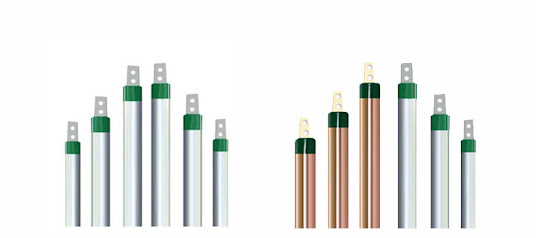
Chemical earthing uses bentonite or graphite based compound along with earthing electrode either a pipe or a rod made of copper or galvanized iron (GI) that helps in improving soil condition and reducing the soil resistivity.
The pipe containing the flat strip is packed with chemical compound and called backfilled. The surface area for dissipation of heat generated is increased. Installation is easier as electrode is dug into ground up to appropriate length of 2 meter or 3 meter. Where the resistivity of soil is high, it is more effective as such the backfilled compound provides low resistance value. no need to pour water at regular interval except in sandy soil so it is also called maintenance-free earthing. It has longer life compare to conventional earthing. It has Constant ohmic value.

chemical earthing compound
Generally salt and charcoal are used to improve the earth pit resistance which is as per IEEE 80 14.5 (a). It has certain drawback as salt and charcoal leach to the soil so we have to maintain the earth pits in regular intervals.
Chemical compound enhances the soil conductivity like Bentonite and other chemicals. As per IEEE 80 14.5 (d), there are certain compounds which has resistivity less than 0.2 ohm meter which has a life span of more than 10 to 12 years.
Component of chemical earthing
· Pipe or Rod
· Backfilled compound
· Earth pit cover
· Fasteners
· Connecting link
· Earth strips
Here we will discuss backfilled compound and cover, rest is same as in conventional earthing.
Earth Pit Cover
True Power Earthing is well-known Earth Pit Cover Manufacturer and Supplier in India. Earth Pit Cover gets used for covering up and protecting earth pits. High-density polypropylene is used to make Earthing Covers. It have good chemical resistance and absorbent-free. These are ecologically friendly rust Proof. It has removable lid for Pit Inspection. Over the earthing top, Earthing Pit Covers are provided for health checks as well as checking and recording Earthing Resistance Value. Our company provides the best quality Earth Pit Cover, which is built of high-grade, durable materials and the most latest technologies. We are also known for Polyplastic Earth Pit Cover , FRP Earthing Pit Cover,Earthing pit and so on.
Product Details:
Minimum Order Quantity300 Piece
Material- Earth Pit Cover
Color Green
Height10.20 Inches (270 mm)
Bottom Size11 inches (340 mm)
Top Size9 inches (260 mm)
Brand True Power

Backfill Earthing Compound
It improves the conductivity of the earth electrode and ground contact area. Compound enhances the earthing effectiveness, especially in areas of poor conductivity (rocky ground, areas of moisture variation, sandy soils, etc.).

Compound typical name: True Power
Features:
· Typically it is non-corrosive in nature having low water solubility but highly hygroscopic.
· It is non explosive, does not cause burns, irritation to eye, skin etc.
· It has high conductivity, improves earth’s absorbing power and humidity retention capability.
· It is so called maintenance free
· Typically it is thermally stable between -10 deg.C to + 60 deg.C ambient temperatures.
· It is suitable for copper or GI type of electrode and different kinds of soils of different resistivity.
· granule size 0.1 mm to 3 mm
· It is little alkaline in nature with pH value >7 but <9.
· User demands -Test certificate from NABL approved lab.
Quantity of backfill compound
For Example:-
· To backfill an earth pit containing 1 no. copper earth rods in 3.m deep, 0.25m diameter bore 1 holes will require the following volume of Bentonite clay compound:
Contact us:
Call us: 8318455691
Email us: seotruepower@gmail.com
Address: D 242, Sector 63 Rd, D Block, Sector 63, Noida, Uttar Pradesh 201301
For more information visit: https://www.truepowergroup.in/
True Power Earthings Private Limited

Comments
Post a Comment